When news emerged that Trae Young is open to a move—and that Washington sits high on his list—the immediate reaction around the league was predictable: Why would either side want this? The Hawks appear ready to turn the page, and the Wizards are miles away from contention. On the surface, it feels like a deal born out of misalignment. Look closer, and it becomes a revealing case study in how NBA teams define success at different stages of their lifecycle.

This is not really a story about Trae Young’s talent. That debate is settled. Few guards on the planet can bend defenses the way he does. His scoring gravity, passing creativity, and deep-range audacity have powered top-tier offenses for years. The real question—and the one Atlanta has quietly answered—is structural: what does building around Trae ultimately buy you?
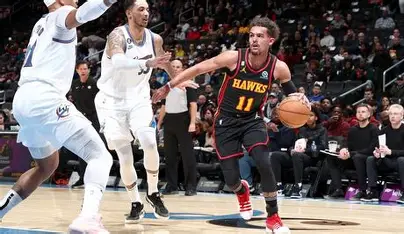
Atlanta’s verdict: brilliance with a ceiling
The Hawks have spent nearly a decade experimenting with the same premise: surround an elite offensive engine with enough defenders and shooters to offset his limitations. At times, it looked promising. The 2021 Eastern Conference Finals run wasn’t a fluke, but it also wasn’t a foundation. Since then, Atlanta has hovered in a familiar purgatory—good enough to matter, never good enough to scare anyone in May.

Internally, the Hawks have reached a hard conclusion. Young’s teams score well with him on the floor, but they bleed points just as consistently. In playoff environments, that weakness is hunted mercilessly. Atlanta now sees its future in Jalen Johnson, a two-way star archetype whose value scales upward in the postseason. From a front-office perspective, that’s not personal—it’s strategic.
So why Washington?
Here’s where context matters. The Wizards are not asking the same question Atlanta is. Washington is not weighing championship probability. It’s weighing relevance, development, and trajectory.
For a rebuilding franchise drowning in losses, Trae Young represents structure. He brings offensive order to chaos. Young-led teams win games they have no business winning. He turns young bigs into rim-runners with confidence, wings into shooters with rhythm, and rebuilding seasons into watchable basketball. For a fan base starved of direction, that alone has value.
There is also a developmental argument. Young guards often stunt growth around them by monopolizing usage. But in Washington’s case, the alternative is something worse: prospects developing in losing environments without accountability or clarity. A high-IQ offensive organizer can accelerate learning—if the coaching staff has the spine to prevent the offense from becoming a one-man show.
The risk the Wizards must acknowledge
This is where Washington must be brutally honest. Trae Young does not raise ceilings—he defines them. You don’t trade for him believing you’ll someday outgrow him. You trade for him knowing exactly what he is and designing around that truth.
The danger is familiar: prospects turning into spectators, the defense collapsing under playoff pressure that never quite arrives, and a franchise drifting into expensive mediocrity. Washington cannot afford to repeat Atlanta’s mistake of mistaking stability for progress.
If the Wizards pursue Young, the terms matter more than the talent. They cannot sacrifice premium prospects. They cannot lock themselves into long-term salary rigidity. And they cannot pretend this is a future championship play. It’s a bridge—nothing more.
Why this move still makes sense (conditionally)
There is a narrow lane where this works. Young’s contract timeline, combined with Washington’s expiring deals and surplus picks, creates optionality. If Atlanta sweetens the deal to move off money, Washington can afford to take a calculated swing. Young boosts competitiveness, sells tickets, sharpens young players—and remains movable later.
In other words, this is not about belief. It’s about leverage.
The bigger takeaway
The Trae Young–Wizards conversation reveals something deeper about today’s NBA. Not every franchise is chasing a ring in the same way. Some are chasing competence. Some are chasing identity. Some are simply trying to stop losing the room.
For Atlanta, moving on from Young is an admission that offense alone no longer defines modern contention. For Washington, flirting with him is an admission that rebuilding without structure can be just as damaging as rebuilding without patience.
If this trade happens, it won’t be remembered for what it wins. It will be remembered for what each team finally admits about itself.